The Misshapen Road to Doomsday
Vaticinium Ex Eventu
The Marvel Cinematic Universe’s fortunes have been dismal the past few years. A franchise that was once a rocket straight to the stars has instead been a roller coaster begrudging its transition from wood to metal. The groans in a well-worn formula it helped patent have never been more obvious, and its greatest hits since the pandemic have relied almost entirely on what you remember loving rather than what they’re committed to endearing to you. Poor reception to Ant-Man and the Wasp: Quantumania coupled with Jonathan Major’s swift implosion canned whatever groundwork Loki had laid for The Kang Dynasty.
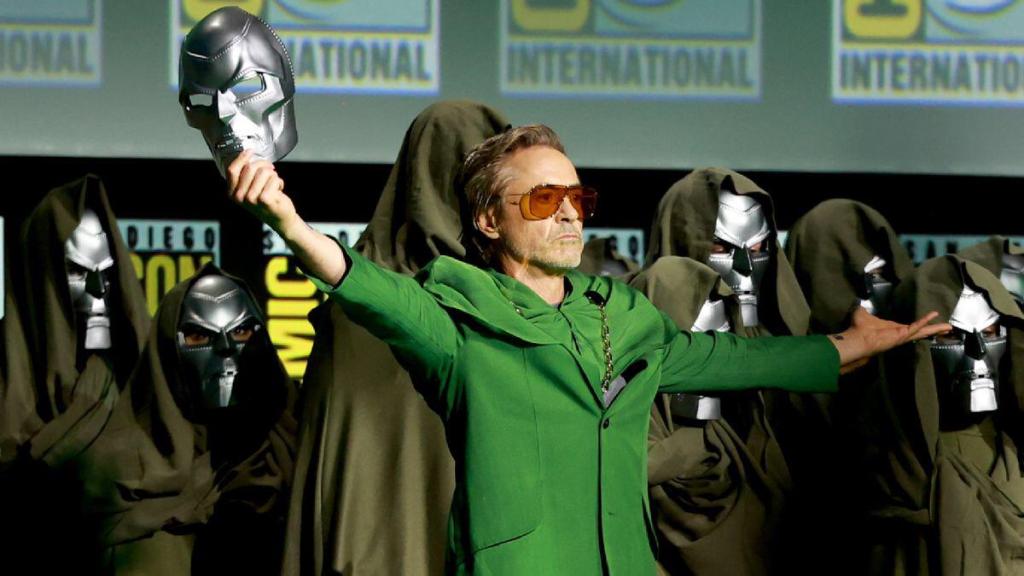
So now the Marvel octopus has dedicated each of its ever-reaching tendrils to convincing you that Dr. Doom was the plan all along. Dr. Doom is a hail-Mary, a publicity stunt that relies on Marvel’s most storied comic book baddie being played by Marvel’s most storied cinematic actor. It promises to pull the X-Men it left behind and the Spider-Men it sold the rights to in its most desperate hour into the fold as if that was the intention all along. Unlike Madame Web, however, this web doesn’t connect them all.
Underplaying Thanos
The problem that Marvel faces is that most fans and casual movie goers are aware that the publicity stunt is a stunt. Unfortunately for Marvel, its own success is its biggest detractor for its continued momentum. Audiences saw peeks at Thanos for years. They came in small post-credits cameos, a minor role, and two movies dedicated to exploring his daughters’ trauma from being raised in his house. When Thanos stepped onto the scene in Infinity War, we’d been groomed to dread him since 2012’s The Avengers. We hadn’t truly met the man, but we were well familiar with characters who dreaded him and everything he might represent.
When it comes to Dr. Doom, all we’ve seen are the back of an unnamed head at the tail end of Fantastic Four: The First Steps and RDJ pulling off his mask at Comic Con. Kevin Feige has been trying hard to spin the narrative, but it is impossible to do so without admission of the fact that the intricately planned MCU has had a much more spaghetti-at-the-wall approach since the Stan Lee cameos ceased. It’s an insult to the average viewers’ intelligence to suggest that the build up to Thanos is all in their heads. It saves face on Dr. Doom, but it forces Marvel to choose between the similar to Doom narrative of blindly stumbling into Thanos or pivoting last minute to recoup from Kang.
Playing Politics
No, I’m not talking about Joe Russo’s groundbreaking two lines as a gay character, I’m talking about the politics of the MCU. The stench of corporate synergy clings to Avengers: Doomsday like Procyon Lotor to the bark of Flora Colossus. In a world where Barbie and a Robert Oppenheimer biopic are towering over Captain America and Thor, Marvel needs a carefully calculate an overdose of what people like to get them consistently passed the $1 Billion box office haul again.
Unfortunately, the market research only validates the notion that people want to see more of what they already know in this type of movie. Marvel’s biggest hits post-Endgame and pre-Doomsday announcement have been Spider-Man: No Way Home and Deadpool and Wolverine. Both of these movies are layered in more nostalgia than a Southern belle is in layers of cotton. They are two movies that are best illustrated by the gelatinous raisins from Better Off Dead. It has raisins, you like raisins, so you should enjoy this abomination. (Although admittedly I like one of these movies much more than the other.) The result of both is a flat film with things you know you like in a concoction that doesn’t sit the same way in your stomach.
Aesthetics vs Substance
There’s a Seinfeld cold open where Jerry Seinfeld talks about how people don’t really root for teams, they root for clothes. It’s one of my favorite bits, and I’ve mentioned it repeatedly on my Letterboxd. The gist is that people don’t really care about the player or the game, they care about their identity with the team and everything else waxes and wanes irrelevantly so long as they have the right clothes on.
The 2020’s have cemented comic book movies as a “cheer for the clothes” type of event. The absurd cameo craze of projects like The Flash, Ahsoka, The Mandalorian, Spider-Man: No Way Home, and Deadpool and Wolverine have proven that studios firmly believe audiences crave a 2-second shot of a costume from a movie they liked in 2006. These movies are focused on the aesthetics of what you grew up liking, and in doing so they completely miss the deeper layers that make these characters and movies both so memorable and so endearing. They amount to little more than catnip on top of dry food, convincing our animal brains to dig into something that isn’t the same above the surface as it is beneath.
The Juggernaut and the Octopus
The best two characters to understand this tradeoff between aesthetic and substance are none other than Dr. Octopus from Sam Raimi’s Spider-Man 2 and Vinnie Jones’ The Juggernaut from X-Men: The Last Stand. Let’s start with the mindless example first.
A Tale of Two Juggernauts
In X-Men: The Last Stand, Vinnie Jones has maybe three lines in the entire film. His Juggernaut is mainly there to smash Wolverine in one fight scene and get dunked on by Shadowcat in another. What makes that character a standout in the movie isn’t his comic book roots- not even a wink at the fact that he’s A: not a mutant and B: Professor X’s half-brother. What makes him iconic is Vinnie Jones’ cockney accent and pissed off delivery. So naturally, when he appears 18 years later in Deadpool and Wolverine, it’s not Vinnie Jones but a generic big guy wearing the ugly The Last Stand costume. In this example, we are quite literally expected to cheer for the clothes of a character stripped of what little identity he already had. To make matters worse, we got a solid Juggernaut in Deadpool 2 that required neither Vinnie Jones nor his costume; and he is nowhere to be found.
Science Squid
In opposition to this is Doctor Otto Octavius from Spider-Man 2. Alfred Molina returned with a gaggle of other Spider-Rogues in 2021’s Spider-Man: No Way Home. The problem is that the movie treats all of these villains like a joke and is far more interested in recreating memes than it is finding a coherent arc for any of them. None of them get done dirtier than Doc Ock.
Octavius is presented as a bumbling idiot easily subdued by nano-tech and one-shotted by the Green Goblin’s glider. His name is the butt of a joke, and he spends most of his scenes yelling at a green screen like an elderly customer wielding a coupon for the wrong restaurant. His big emotional scene comes when he meets Tobey Maguire’s Peter Parker in the third act. He notes that Peter is all grown up and Peter soulfully remarks that he’s “trying to do better”. It is a callback to one of their first conversations in Spider-Man 2 that reaches into your heart with the subtlety of a Mortal Kombat finisher in an attempt to pull on your heart strings.
Trying to Do Better
The original conversation this references in Spider-Man 2 comes after Otto is forced to spend the day with his financier’s best bud, Peter Parker. He chastises Peter for being brilliant but lazy. Peter responds “trying to do better” and Otto immediately serves him a double helping of put downs. “Intelligence is not a privilege, it’s a gift; and you use it for the good of mankind.” It echoes the sage words of Uncle Ben, that “with great power comes great responsibility”. This scene transitions Dr. Octavius into that avuncular role, guiding Peter and ultimately providing the foundation for Peter’s internal choice to later confront him.
In the context of this scene, “trying to do better” is an excuse for Peter’s failure to appear in his own personal life. When it is given its applause moment in No Way Home, it’s meant to be some callback to catharsis. In reality, its little more than the way AI processes writing. It rips from something it doesn’t have the capacity to think through or generate, only to mimic it because it is familiar. It is the clothes we’re expected to cheer for, not the substantive person beneath.
Rewearing Dirty Clothes
Above all things, Avengers: Doomsday promises to assemble the coalition. Thus far we’ve confirmed the greatest hits of Wolverine and the Bryan Singer X-Men films. We know for a fact that the band of Robert Downey Jr, Chris Evans, and Chris Hemsworth are set for a reunion tour. There is credible speculation that Tobey Maguire’s Spider-Man gets a front seat to the action. And there are even rumors of wild cards like Eric Bana’s Hulk in the fray.
Marvel is assembling the coalition from every corner of its 50+ big budget adaptations in a cinematic buffet of at least one person that each of the four quadrants would remember seeing in their youth. It is banking on the fact that children as young as seven and anyone alive prior to the 21st Century will have grown up with a fondness for one facet of its many franchises. Marvel is prepared to wear them front, to wear them back, to wear them inside out, then front and back again.
Dog Meet Vomit
When I was a freshman in high school, there was a senior on my school’s basketball team who was widely regarded as one of the best in the league. That year, especially, because his biggest rival had graduated and was playing ball for KU. However, when it was his turn to graduate and play collegiate ball, he quickly fell in the rankings. The once surefire NBA pick now plays in an Eastern European league. If returning to USD 259 was an option, I’m certain he would have taken it. Why? Because it is much easier to play as future NBA prospect than it is to play in the NBA.
It’s common for stars with major roles like this to fail to build a parallel career or find success afterwards. Chris Pratt, Scarlet Johansson, and Mark Ruffalo are the rare stars to have achieved steady outside success alongside their Marvel rise. Chris Evans, Hugh Jackman, and even The Russo Brothers haven’t been so lucky. They have all struggled to maintain the same commercial and critical success once they’ve put down the shield, the adamantium claws, and the infinity gauntlet.
The consumer need to see someone wear these clothes and the set-backs of post-Marvel careers create an opportunity when big names need big franchises just as much as these franchises need them. In 2008, Robert Downey Jr needed Marvel. In 2026, Marvel needs Robert Downey Jr. He is reportedly pocketing $100million+ for Avengers: Doomsday and Secret Wars. Even at this rate of inflation, that’s an obscene amount of money.
Bloated Budgets
When stars demand $100 million paydays, budgets get tight really fast. A surefire $1-$2billion dollar hit can afford it, but a corporate disdain for profit sharing means the corners will need to be cut somewhere. The reported budget for Avengers: Doomsday is around $400million prior to marketing expenses. The film is expected to need $1.5billion dollars just to break even. When one star is taking up 25% of the total budget, and every other star you can think of requires substantial millions to lend their face, the money gets shored by the above the line cast and much like it does in the real world, it doesn’t bother to trickle down. This is especially true when courting as many named stars as these films promise too.
This means that production windows are shorter. Fewer positions are available on set. Production design is pulled back. It means the movie looks less like something shot in a real place and more like something improvised in front of a green screen, because it is. These types of movies spend so much money on the clothes, that they completely suffocate and dispose of the people actually charged with making the movie. Whether Marvel realizes it now or will realize it in the wake of Secret Wars, they are in dire need of a Moneyball style rethinking of its strategy. An all-star team might work to recoup this losing season, but it isn’t a sustainable model. They need a hard reset to bring star fees down and start putting resources into the periphery that makes it work. The strength of their early success is in the aggregate, and if Disney doesn’t realize this as a whole they are going to spend the next decade with a tail between their legs and a consumer boot in their rear.
Ultron is Awake
Unfortunately, Marvel has addressed this by jettisoning their periphery in the lead up to the Doomsday/ Secret Wars double header. Disney announced a massive slew of layoffs recently, with no department quite as mercilessly gutted as Marvel’s Art Department. The team that spent two decades designing the look and feel of those clothes you love were cut loose in an afternoon. Now, Marvel is kind enough to freelance to those exact same people, but therein lies the problem.
Marvel chose its aging stars with big salary demands over the team players that have kept the engine oiled and the bearings greased. When the stars leave, who is going to be there to keep consistency? The ugly truth is that Marvel and Disney are no different than Jack Welch’s GE or any other megacorporation. When profit is the guiding motive; there is no cost in human livelihood that can’t be culled at a moment’s notice. AI isn’t being used as a tool to stimulate human creativity or streamline a process; it is being used to cheapen human labor. It’s not there for a better consumer product, it’s there for a wider profit margin. Now the self-proclaimed “prompt engineers” can legally ripoff the fired artists’ work and then freelance them to pretty it up. A consistent job with a salary and benefits is now a sporadic one time payment with no promises of consistency or mutual respect.
Playing Monopoly
Marvel is already struggling to differentiate its paint by numbers designs from the cheap crap you can stream in the background at home. As AI takes a more active role in project design and completion, what was once the blockbuster equivalent of a fresh cooked burger is diminished into a mass producible frozen patty. If the choice is between heating up your own Soylent Green at home or paying someone else to heat it up on a bigger plate; what choice is there really?
To add salt to the wound, Marvel’s best success post-pandemic is a property they rely on another studio to make. Marvel and Sony exist in a bond like Venom and Eddie. In my opinion, Spider-Man: Brand New Day is a huge step in the right direction. However, it is only one spider in a garden full of flies. Hopefully, lessons are learned, but Sony never really has been good at learning lessons from its Spider-franchises.
We’re watching Marvel, and its parent company as a whole, make some desperate decisions. As the philosopher Michael Gary Scott once mused, “desperate situations yield the quickest results.” I have no doubt that Avengers: Doomsday and Avengers: Secret Wars will make the GDP of a small country as they sail your favorite spandex t-shirts and leather jackets into the sunset. When the road to Doomsday reaches its Secret Wars end and there’s no more ace to play, with the board full of pawns nowhere near being promoted Queen, what nostalgia bait will be left?
As Marvel’s own creation once said, “Dread it. Run from it. Destiny arrives all the same.”

