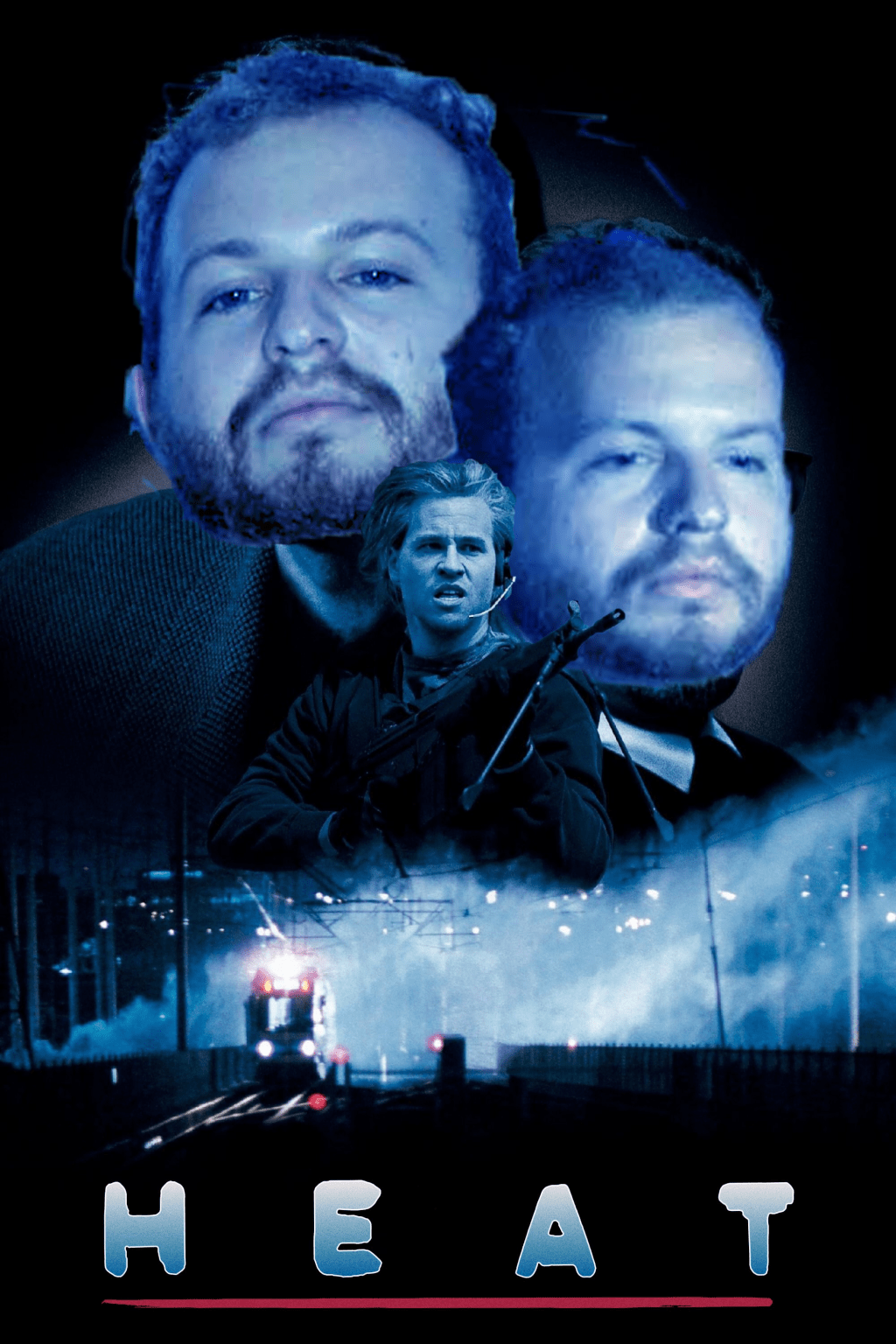
I’ve been tossing around a few loosely structured ideas this past week and I’ve struggled to figure out the right framework to string them all together with. This morning an idea finally hit me. A little over a week ago I sat down to rewatch the movie Heat, one of my personal favorites. Soon after I found myself re-reading Heat 2, a recent novel continuing and prequeling the original story. So I figured, “why not take the two things on my mind and find some connective tissue between them?” I think the media we consume and the characters we encounter can often present us with unique angles into our own experiences and so today I’ll use the methods of Neil McCauley and the angst of Vincent Hanna to pick apart my own experience a little.
Lauren
I’ve talked about anxiety a lot lately on this blog as it has been a heightened issue for me since April. In the movie Heat, nobody exemplifies anxiety quite like Vincent Hanna (Al Pacino)’s step-daughter Lauren (Natalie Portman). Her opening scene in the movie revolves around her scouring the apartment in a fit looking for hair clips. Her real father has a habit of making plans and not showing up, something that constantly displeases Hanna despite the fact that he is also doing it to Lauren’s Mom (His wife). Lauren throws a fit because she is afraid that if she doesn’t find the hair clips then she won’t be ready and if she isn’t ready, then her father will bail.
Now, her father does indeed bail, but it isn’t because she isn’t ready. Her father fails to show because that is who he is, and that is how little effort he’s willing to pull out of his own life and put towards his daughter. Her anxiety places the blame and the expectation on herself, allowing her adult father to walk all over her and remain exonerated.
“I can’t be late”
Control is a fickle thing. One second we feel like everything is nice and orderly under our thumb and the next we don’t even have sight of the reigns anymore. I have struggled with control endlessly in my previous two relationships and especially in my professional life and career. In my abusive relationship I was a lot like Lauren, adamant that if I just did X faster or Y better or Z perfectly then the other person would act they way I needed them to. X, Y, and Z did not make that girl a less abusive person. Control was never something in my grasp and the Boxer mentality of “I must work harder” only stretched me thinner and thinner.
Control looks different in reflections of my most recent relationship. I wasn’t being abused and until things were terrible things were generally going really well. There wasn’t much of a slow descent that I saw coming. One second I had a hand on the wheel and the next second the car was in a ditch with the wheel nowhere to be found. Control looked like me reflecting on would have, could have, should have’s. In reality if I would have said those things that I could have or should have, I still would have been cheated on, because I cannot control the behaviors that lead her to seek greater attention from someone more accessible.
I cannot change them, my past self or what happened in either of those circumstances. No matter how deeply I dissect them or how earnestly I seek to understand why they did what they did. Reflection and dissection can be healthy in certain amounts, but if we trap ourselves in the cycle of trying to perfect broken relationships we’ll do nothing but drive ourselves into fits looking for hair clips we lost a long time ago.
Lt. Vincent Hanna LAPD
I gotta hold on to my angst. I preserve it because I need it. It keeps me sharp, on the edge, where I gotta be.
The lead of Heat is Vincent Hanna, a Robbery Homicide Detective whose marriage is in shambles, who obsesses himself to near insanity, and who runs in stark parallel to Robert De Niro’s Neil McCauley. Hanna lives for his work, finding his meaning in what he’s going after, and shoving everything in his personal life to the side in order to do so. Hanna isn’t so different from Lauren, incapable of letting go of what he’s going after to live in what he has. I don’t think Hanna is entirely wrong in this. Wanting to catch a crew with multiple murders and high profile scores under their belt isn’t dishonorable. Neglecting your wounded family in order to do so is.
Vincent Hanna is erratic, impulsive, loud, and violent. I do not find as many temperamental parallels to him as I do Neil McCauley, but I absolutely see myself holding on to unhealthy habits and obsessions the way he characterizes in the movie. Hanna might be the film’s protagonist, but that does not mean he’s someone we are supposed to emulate or at times even empathize with.
“All I am is what I’m going after.“
Defining ourselves is difficult. Vincent Hanna defines himself by the victims he’s seeking revenge for, the criminals he’s chasing, and the high he gets from closing the case. He doesn’t define himself based off of his personality, his family, or the reasons why he pursues his work. He defines himself off the high that being the heat and bringing those guys down gives him.
I have always struggled with defining myself and my worth from what I think other people think of me and the attention they give. Getting cheated on squashed whatever sense of self worth I had. I wasn’t getting the attention I was accustomed to from my girlfriend and on top of that she stopped giving it to me so she could give it to a meaningless fling. As I unraveled more of the details of what had happened I felt smaller and smaller, and it was because I was defining myself once again by someone else’s relationship to me.
“My television set!“
The entire first two thirds of the movie, Vincent Hanna and his wife Justine slowly circle the drain of their marriage (Vincent’s third). In the third act Hanna comes home to find another man lounging around on the sofa, watching TV while Justine cooks him breakfast. The ever alert Hanna gets an instant read on the situation, confronting his wife and her lover not about their affair but the fact that Ralph is watching Hanna’s television set. Hanna violently rips the 12in TV and its rabbit ears from its cords and exists the house with nothing else. Shortly thereafter he throws the TV out the passenger door of his car and drives off.
There’s much more running beneath the surface of this scene but I want to focus particularly on the TV set. Hanna knew that he couldn’t control who Justine allowed into her ex-husband’s apartment, or that Ralph was covetous of her, but he could take with him what was his. Just because we can take something with us doesn’t mean we need to drive around with it forever. Once the emotion has died down a little, Hanna realizes that the TV is useless outside of that house and promptly disposes of it.
“I do what I gotta do.”
I’m not a Vincent Hanna. Violent reaction and impulsive behavior just don’t come naturally to me. Ask my family or my close friends how often I get legitimately angry, it doesn’t happen very often. As I found out that I’d been cheated on, I felt a lot of anger and resentment to a degree that I haven’t felt in a long while and like Lt. Hanna I decided to take what was mine with me. The difference between us is that I didn’t drop the TV out of the vehicle. Instead I chose to spend several months driving around with it in the passenger seat, pretending like it wasn’t there.
I talked about hate in Choosing Barabbas. I believe that hatred is wrong, regardless of what another person does to us. I used that belief to pretend like I wasn’t angry and I wasn’t upset, forcing all of those emotions down like mentos in a coke bottle. pressure building and building ready to burst out the moment there was an opening. The girl that cheated on me got off easily because I pretended to myself and to her that I had a grip on my anger. The reality of the matter is that that anger sat in the seat next to me, a constant reminder of what had happened and how the matter was still internally unresolved. I was holding onto my angst and it was keeping me sharp, but fixated on the wrong thing.
Neil McCauley
Don’t let yourself get attached to anything you are not willing to walk out on in 30 seconds flat if you feel the heat around the corner.
In opposition to Vincent Hanna is Neil McCauley. Neil is a career criminal, patient, precise, principled, and always in control. He’s not emotional or erratic like Hanna or his own crew, he keeps a lid on everything and has a pulse that never rises above 60bpm. Hanna knows that sometimes you have to get loud and smash the TV, but Neil likes to pretend that his principles have dictated and diminished his emotions. This is the character I see myself in the most.
While Hanna’s romantic life is falling apart, Neil’s is coming together in ways he wasn’t prepared for. A chance encounter, a desire to belong, and Neil falls in love at a time when a relationship is the least appropriate thing in his life. Neil is so used to having his emotions in check and playing it cool that when love comes and he feels things he can’t control, he gets reckless and ends up throwing out his perfect plan to serve his anger and his love.
“Dead man on the end of this line“
I was so adamant that hate was bad that I failed to distinguish the difference between it and anger and really let myself feel what I felt for the longest time. Then about two months ago I had a brief argument with a friend and that little twist of the lid was all the coke and mentos needed to blow the whole thing open and gush out. I sat down on a bench at the TTC and cried for half an hour, every ounce of sadness, anger, hurt, and regret flowing out uncontrollably behind my pair of sunglasses and a couple dozen sniffles. It took some of that anger burning off for me to realize just how much I was pretending not to feel, and by pretending not to feel it I was denying myself the ability to genuinely process it and get through it.
“My life’s a disaster zone“
When we ignore what we are feeling, we make ourselves incapable of understanding ‘why we are feeling’. It took that unexpected and uncontrollable overflow of emotion for me to be able to acknowledge the internal work that I had to do. At the root of that work lies the ability to temper expectations and accept that my actions cannot dictate someone else’s behavior. I have to learn to accept myself and others as independent, driven by different motivating factors, and responding to the same events in vastly different ways. This has been especially pertinent when it comes to communication and how I’ve tried to rebuild my social life without my ex-girlfriend being the center of it.
“Flip side to that coin“
About halfway through the movie, Neil and Hanna meet for what is to become one of only two times. It’s a conversation at a diner, both men sitting down to finally greet their opponent face to face, hoping to walk away with insight into the other without giving away too much about themselves in the process. It is the only scene in this movie where either man converses with someone who genuinely and completely understands them. It is a scene filled, surprisingly, with a lot of tender moments as these two men build the closest thing either of them will ever have to friendship. They both have to open themselves up in a way that they are unwilling to do with anyone else. Both McCauley and Hanna leave that conversation with a fuller picture not only of the man sitting across from them, but of themselves as well.
“Brother, you are going down“
I’ve always had a desire to understand people but I think I have always struggled to pull my own perspective out of their lives. Whether its friends, family, relationships, what have you, it’s a lot easier to just place our own lenses into the frame and view things the way we would see them. As I’ve gone through therapy again these past couple months and done the soul searching I’ve been challenged to force myself out of my own shoes a bit more. It’s uncomfortable because the more of an effort we make to observe or understand another’s behavior, the more we are forced to notice unhealthy deviations in our own behavior.
“Talking to an empty telephone“
In Demon Box I talked about how much of a distaste this whole process has given me for my cell phone. AT&T is not responsible for my lack of boundaries and unfounded fears, but the service I pay them for does enable those behaviors within me. My phone is always on me or at the very least within arm’s reach. So when I get a notification I respond to it the literal second I see it. I always saw this as “well I don’t want them to think I’m ignoring them.” Which means I’d respond even if I wasn’t really available, even if I knew I needed more time or better headspace to carry on the conversation. Why? Because I don’t want to disappoint anybody. And in my headspace them reaching out shows that they need something from me and I don’t want this to be the time I let them down. So if I reply quickly it will show them that I care and that will make them care. That train of thought makes sense to me, which is why I was very taken aback when my therapist insinuated I don’t set boundaries.
I was confronted with an uncomfortable truth, the notion that not every behavior reads the same way to every person. I had also created an impossible standard for which to gauge how other people thought of me or felt toward me. Because I was showing how much I cared by replying as quickly as possible and pouring all of my attention to them, I was setting myself up to be let down because they took 20min to text me back and I only took 20seconds. I was creating scenarios to reinforce negative impressions of myself by slapping my own interpretations and behaviors universally onto everyone else.
“All the way up it”
These past few months I’ve been forced to sit across the table from myself and really dig into what parts of me I truly do understand and what parts of me I merely think I understand. It has been a constant headbutting between principles and emotional realities, a comparison and contrast between what I believe and how I express that belief. I’ve had to humble myself before my own emotions and accept the fact that I often feel things that I do not want to feel. And I’ve been so afraid of feeling things like anger and bitterness that I have inappropriately conflated the feeling with the reaction. To be angered is one thing, to act on it is another, and I was so afraid of that action that I bottled the anger and its companion emotions to the point they overwhelmed me.
Having had a couple months since that coke and mentos explosion, I’ve had time to sit across the table from those emotions, to understand them, and to accept that they exist rather than to keep on ignoring them.
“This crew is good“
What use is our ideology if it is not tested?
-Andrew Ryan
The above quote is from Bioshock, not Heat, but it felt too apt to be excluded.
More than anything lately I have found myself coming into more internal conflict than I think I have ever had before. What I believe and how I behave have butt heads more times than I can count at this point. And I look back on those encounters proud of myself, because for the most part I’ve seen what I believe to be right triumph within me. It hasn’t always been true, and I am far from infallible, but I have seen myself hold McCauley-like restraint more than I’ve seen myself dole out Hanna-like outbursts.
When I sat down with my ex in May I told her that “doing the right thing is more important than feeling like I got my revenge”, something reflective of the personal mantra I have that “doing the right thing is more important than having the right thing”. It’s the reason why she never read the angry texts I began to type, why I’ll never go into more specific detail about what happened here, and why I choose to do the work internally that I need to in order to heal properly.
At the same time, quite a few of those internal beliefs have been exposed and proven ill. The lack of boundaries, the unwillingness to acknowledge emotion, the need for control; those internal beliefs have to be confronted so that behaviors can change. I am proud of me, because I know that despite the still closing wounds and scars that I’ve taken the past couple years, that I know that I’m still me. And despite the times I’ve disappointed myself and the times when I have not risen to what I expect of myself, that my internal compass still points the right way. I know now that I have the strength to follow that compass, that I have the willingness to walk out in 30 seconds flat, and that I know who I am even when I feel the heat around the corner.

