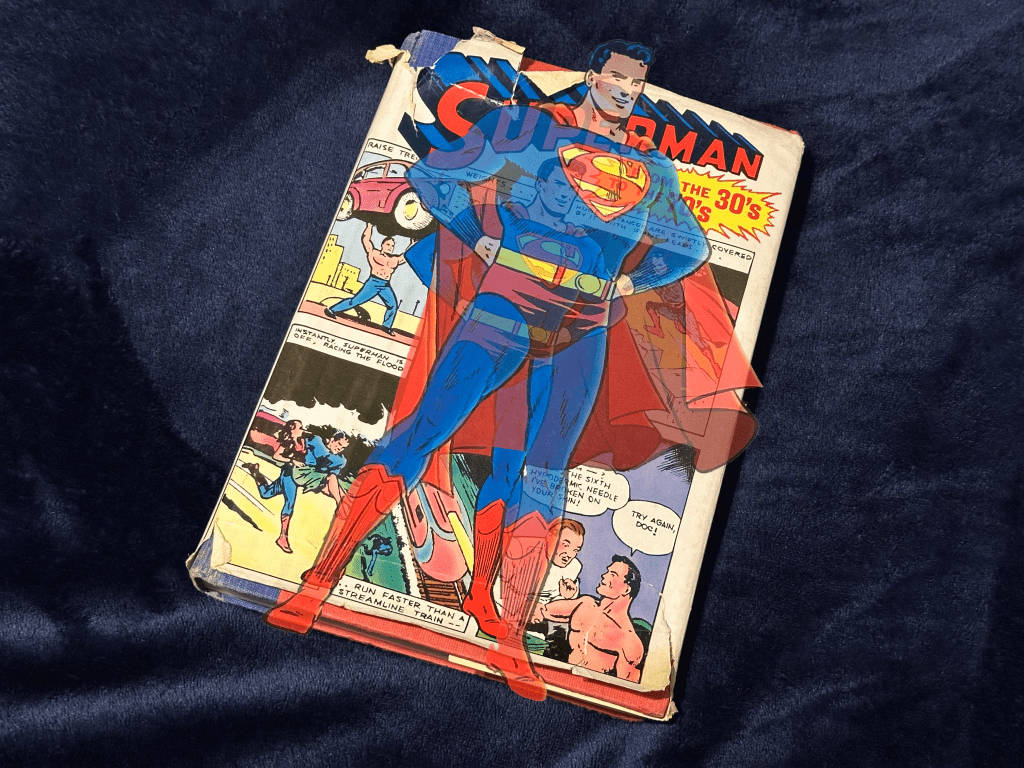
This week Superman (2025) director, James Gunn, made comments about the film and its lead character being pro-immigrant. Naturally, this lead to a ton of outrage on the Right side of the political spectrum, and a lot of blather on what Superman actual stands for.
Is it “Truth, Justice, and the American Way”? Or perhaps its “Truth, Justice, and Freedom”? Maybe it’s even “Truth, Justice, and Peace for All Mankind”? Or, like in recent years, is it “Truth, Justice, and a Better Tomorrow”?
I’ve done a ridiculous amount of preparatory work leading into the new Superman film, and I can think of no better way to focus that than by exploring what exactly Superman stands for and how that has or hasn’t changed over time. Did Superman “Go Woke”? Let’s go back to the beginning to find out.
Action Comics #1
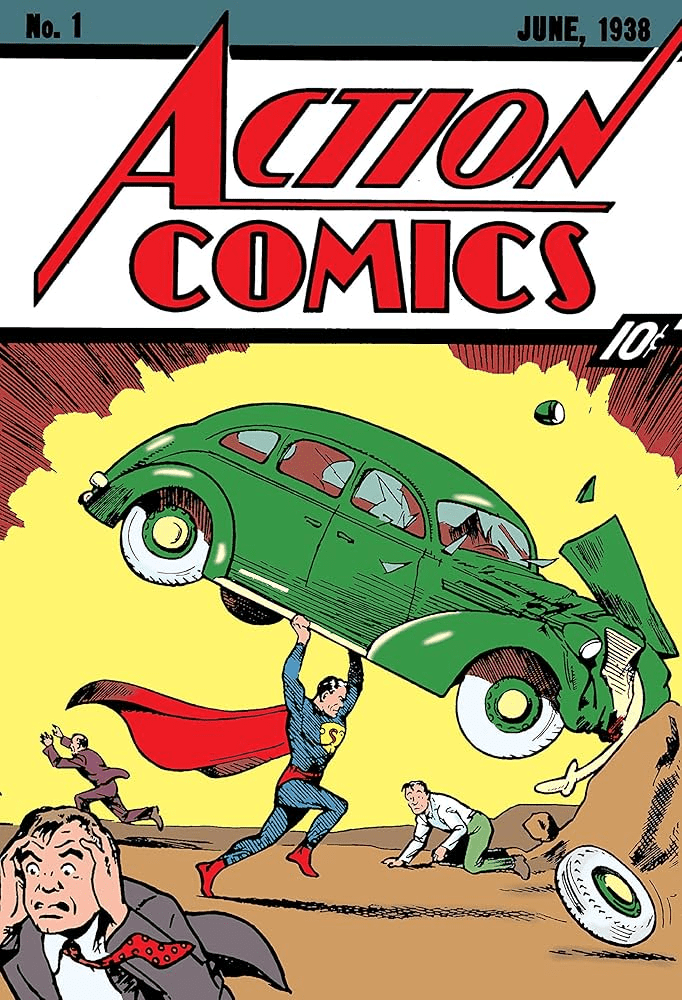
One of the books I’ve had since longer than I can remember is a collection of Superman stories from the 1930s-1970s. It features, amongst others, Superman’s debut in Action Comics #1. It was a time before Krypton had a name, before Superman could fly, and before The Man of Steel had become the superhero. The story briefly recaps Superman’s narrow escape in a makeshift shuttle from his doomed home planet, before introducing and swiftly killing off Ma and Pa Kent as Clark grew up.
It is then the story about Clark saving someone wrongly set for execution by finding the real killer and delivering her to the governor. It’s about Clark Kent taking on the guise of cowardice and Lois Lane slapping a mobster who tries to cut in on their dance. And it ends on a cliffhanging two-parter as Clark Kent uncovers the truth about an arms manufacturer lobbying a US Congressman to keep a war going in the name of profit.
Woke Comics #1
The “wokeness” of Superman struck me in two particular ways. Firstly, Superman takes on some very anti-masculine qualities in being Clark Kent. His power is something that Pa Kent compels him to hide and Ma Kent compels him to use uniquely for the good of others. Not once in his two debut comics does Clark use his power for his own benefit. Instead he saves a stranger in prison, his co-worker, and a foreign nation. While doing so, he embraces sheepishness and humility in the guise of Clark Kent. He intentionally sabotages his relationship with Lois so that Superman can remain free to help others.
Secondly, are the sources of villainy. Superman isn’t fighting the Mad Scientist in his debut, nor Lex Luthor, nor Bizzaro, or any of the dozens of other comical rogues in his gallery. Superman is fighting warmongering, and the apathetic appetites of profiteers. Superman forces an arms dealer to see the war he created first hand and then forces the two opposing generals to either fight it out themselves or call off the slaughter. In a war hungry America, these are very “woke” beliefs.
What Does Woke Mean?
Originally, woke was a term used to describe those who had been awoken to the active detriments of racial injustice. This term greatly increased in the summer of 2020 in reaction to the killings of George Floyd, Ahmaud Arbery, and a few others. Because of the implications it had against law enforcement, gun laws, and vigilantism; it was quickly co-opted by Right-wing talking heads to mean anything that strayed from what they defined as their political point of view. The term has mostly been robbed of its initial meaning and in this case now means whatever Fox News wants its viewers to believe is a far-Left ideal.
In a fairly disastrous first six months of his second term, the one guaranteed home run that Donald Trump still has to placate his base is his stance and policy towards immigration. Legal methods of immigration are being questioned, violence against immigrants is demanded, and their dehumanization celebrated by thunderous applause. To even suggest that Superman is an immigrant and that his stories carry positive commentary on immigration is now a mortal sin.
Immigration Nation
Immigration is what keeps this country going. It has fueled the greatest periods of boom in this nation since America’s rise to world dominance began in the Gilded Age. At every stage of that process, immigration has been pushed against and the definitions of whiteness and acceptability changed. First it was the Chinese, and then the Jews, and the Irish, and the Italians, and today it’s Mexicans (code for Spanish speaking and/or brown) and Muslims.
Now we are even at a point where naturalization by birth is being targeted. While birth right citizen ship has only been constitutionally present since the mid-1800s, the legal precedent stretches far back into the colonial era of the early 1600s. Rounding people up and dropping them in hastily built, moat guarded camps is to be celebrated; but the country’s rich and noble (albeit spotty) history of granting citizenship to those born on its soil is to be feared.
The history of naturalization, legal status, and immigration is a dense and complex issue that has changed greatly over time. If I had 100 of these posts, I could not even begin to encompass the history of the quota system, xenophobia, and all the different races and nationalities that have been at times feared, forbidden, and eventually welcomed into this country. There is simply too much to distill, so instead I’ll focus on ways in which this country’s history and Superman overlap-with antisemitism.
Anti-Semitism and a Modern Moses
Superman is a Moses metaphor from panel one. Like Jochebed placing Moses in a basket upon the Nile, Jor-El (unnamed in Action Comics #1) placed baby Kal-El (then also unnamed) in a rocket and sent him drifting through the cosmos. Superman was created by two Jewish men and his debut issues stand out because of his ambition to inspire and lead others. Like Pharaoh facing the plagues after each “let my people go”, Superman takes the arms dealer deeper and deeper into the conflict with each refusal to change his ways. The climax of his adventures in Action Comics #1 and #2 doesn’t come when he hurls passed a speeding locomotive or lifts a car over his head, but when he forces two opposing generals and an arms dealer to look at the destruction they have caused and to change their ways. The Generals part with shook hands and the Arms Dealer shutters the weapons manufacturing in lieu of fireworks.
Superman looked human, but he was born of Krypton, raised in Kansas, and sent to Metropolis. He was repeatedly sent where he did not belong, but where he needed to be. In the same way, Moses was Jewish but raised in Pharaoh’s house, and often rejected by both his genealogical and his domestic people because of his lack of total assimilation to both.
Much like Moses, Clark Kent is lacking in confidence, stumbling over his words, and unable to lead as himself. As Moses needed Aaron to follow the call of the Burning Bush, Clark needs Superman to answer the call given to him by his parents. While Clark and Superman are not expressly Jewish (after all he was born on another planet), his debut in 1938 comes at a dark moment in modern Jewish history. I’m not even talking about Germany and World War II, I’m talking about the rampant antisemitism in the US and in Europe that only increased their plight on the world stage.
A rather gaping detail about the Holocaust and eventual Jewish resettlement in Israel in 1948 is that they were forced to return to the Holy Land because the other European powers wouldn’t welcome back refugees or even their own citizens for resettlement. Eastern Europe wouldn’t bring them back home, Western Europe turned a blind eye, and even the great United States resisted mass refugee resettlement within its borders. Anti-Semitism was far from a uniquely German trait, and it is from this time where the already displaced Jews of Eastern Europe were under attack and barred even at their allies’ gates that Superman was born.
Adventures of Superman

So now that we’ve talked about the era where Superman was born, let’s talk about the first time he appeared on the Small Screen. Adventures of Superman isn’t Superman’s first live-action or film debut. He’d made the leap to technicolor, and learned how to fly, in 1940’s Fleisher Superman cartoon series. His first true live-action debut was in the film serials of 1948 and 1950 before landing on television in 1951 for what would be his most famous appearance for a quarter century. It was this show, after all, that popularized his catchphrase of “Truth, Justice, and the American Way.”
So as the Cold War began to grip the nation and the first swellings of the Red Scare began, what kind of story did this new and uber-patriotic Superman debut with?
Superman and the Mole Men (1951)
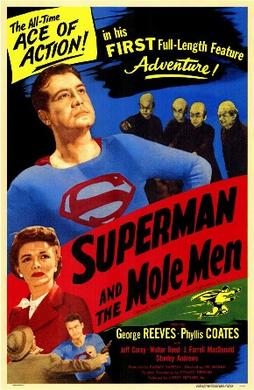
George Reeves’ first outing as the Last Son of Krypton doesn’t begin with a fight against Lex Luthor, Zod, or Brainiac. It begins in a small town, where an oil drill has bored into the Earth’s core and accidentally breached the sub-terranean home of the Mole Men; a childlike species who, unbeknownst to them, are highly radioactive. No, the enemy of Superman and the Mole Men isn’t either of the titular characters, it is the small town residents who wish to shoot them on sight and exterminate them.
Superman spends this TV movie bending shotguns of trigger happy farmers, catching slain Mole Men from waterfalls, and assisting in their surgery when nobody else will. In the end, Superman is able to restore peace enough only for the Mole Men to retreat and close the pathway to the surface that intruded upon them. Superman standing up to red blooded Americans on behalf of the outsiders? Sounds pretty woke to me.
At the peak of American Patriotism and fear of all ideas foreign, The Man of Steel stood for the voiceless, the downtrodden, yes even the immigrant. Even in 1951, Superman’s greatest achievement wasn’t in beating down bad guys over there, but in standing up to the bullies in his own backyard.
Superman (1978-1987)
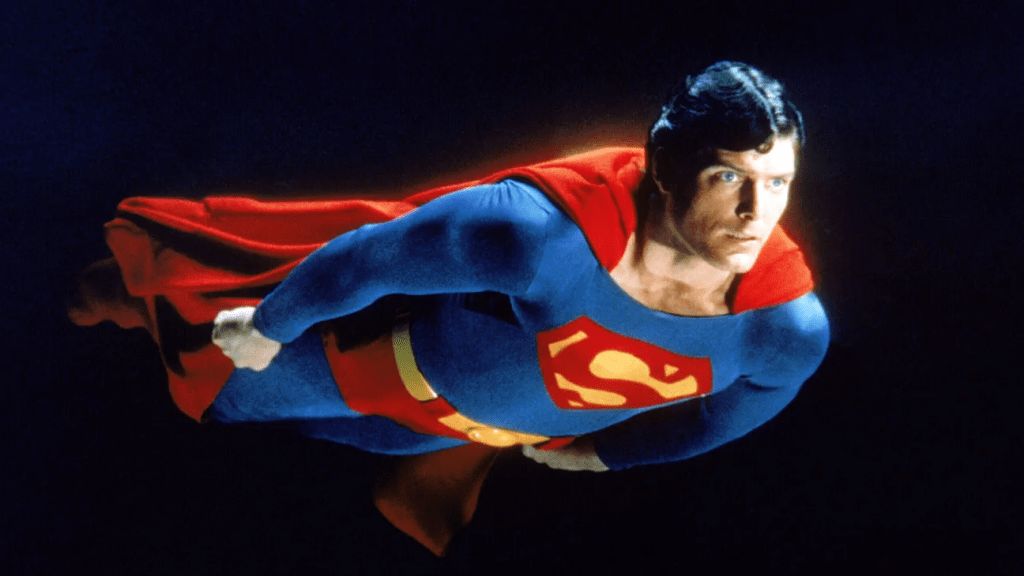
Now let’s jump forward in time and see how woke Superman was when he finally debuted in his own feature length films on the big screen. Christopher Reeve played the Man of Steel and Clark Kent of a generation from 1978 through 1987. His primary adversary in three out of four films comes from his arch nemesis, Lex Luthor.
In Superman (1978), Lex attempts to nuke the San Andreas fault, breaking off a new continent that he intends to profit from greatly. In Superman II, he utilizes the unstoppable force of General Zod, Ursa, and Non to secure himself governance of Australia. He takes a break in Superman III, but returns in Superman IV: The Quest For Peace, with his own quasi-Krytonian creation in an attempt to once again subjugate the globe. Hackman’s Luthor is a real estate mogul, known criminal, and extreme narcissist. Thankfully that doesn’t describe anyone else we know.
Contrasting George Reeves’ Superman at the start of the Cold War, Christopher Reeve’s Superman at the Cold War’s end is much more of a global hero. In Superman IV he even goes so far as to single handedly rid the world of nuclear weapons, contrasting starkly with the policies and attitudes of the Reagan administration at that time. While this film is very flawed, its themes on nuclear escalation and mutually assured destruction resonate even today.
Lois and Clark: The New Adventures of Superman

After 1987, Superman took a long break from the big screen, but would shortly return in a (then) modern re-invention of the original 1951 series. Teri Hatcher and Dean Cain starred as Lois Lane and Clark Kent in Lois and Clark: The New Adventures of Superman. Because Dean Cain has aligned himself with a lot of far right dialogue, this performance gets unnecessarily dogged on, but in my opinion this was the first time in the modern era where the actors were allowed to fully explore Lois and Clark outside of the superheroics.
Lois and Clark was my introduction to Superman as a kid. This was one of the first shows on Netflix that I ever binged, back when each season was its own separate item on the Netflix Wii menu. When Netflix removed it, this was the first series I ever bought in entirety on DVD. I’ve been rewatching it prior to the new film and am thoroughly unsurprised to see Superman’s values having changed little in between iterations.
This take on the character focuses primarily on Lois Lane and Clark Kent as reporters for the Daily Planet, intersecting with various gangsters, criminals, and even Lex Luthor. The show’s first season ends with an arc featuring the redemption of a small-time burglar who steals from Clark, but is ultimately taken under his wing. Seems like a very soft on crime response for a superhero, but ultimately it drives right at the heart of who Superman is.
Superman is often seen as a boy scout and is notoriously difficult to write for because his moral strength is as impenetrable as his skin. That’s why the best Superman stories are almost always about change coming not from within Clark Kent/Superman, but coming because of how he inspires and leads others. Lois and Clark is often a monster of the week show when it comes to its plotlines, but the heart of the show is no different than it was in Action Comics #1. Superman isn’t strong because of his ability to leap tall buildings in a single bound, but because of how he inspires others to look up.
Injustice
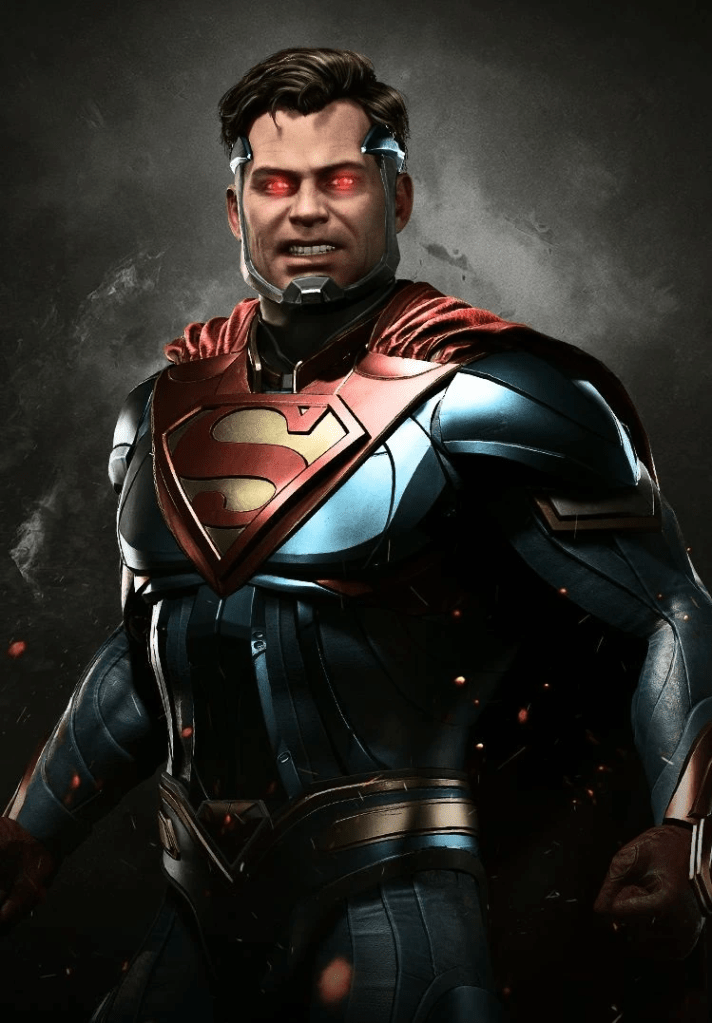
Contrasting that mythos is one of the more recent twists from the Injustice games of 2013 and 2017. In this alternate universe, Lois Lane is killed by the Joker. Broken, Superman decides that instead of inspiring people to do better, he’ll just force them to do better. He punches through the Joker’s heart, establishes a one world government, and becomes the ultimate Authoritarian. This Superman believes in pre-emptive strikes, material dominance, and that there are no means that cannot be justified by their end.
Fascist Superman secures world peace through domineering strength, not raising but subjugating. Those who don’t play by his rules are swiftly dealt with, even going so far as to laser beam the 14-year old Billy Batson’s brain to a boil before he can transform into the artist formerly known as Captain Marvel. He attempts to execute Batman on live television, and in Injustice 2 even attempts to mind control anyone who dissents.
Injustice’s Superman is representative of the strong man tactics that many wish America to use on the world stage. It is a grim reflection of what far-Right ideology celebrates, even if it is a fantastical one at that. The Superman of this series stands out simply because of how unlike Superman he is. Gone is the call to honesty, to what is just, and to freedom, peace for all mankind, and even the American way.
*
The Drifting Right
Superman hasn’t “gone woke”, but his ideals have gained the appearance of being Leftist because of a gradual and concerted effort to pull the Right to its extreme. This isn’t a new trend in American politics, but it is an especially potent one. Xenophobia, authoritarian tendencies, and a redefinition of who is and who isn’t American are problems that America has faced off and on since the day settlers struck out for Jamestown. We live in a nation that has lost its commitment to truth, abandoned its sense of justice, and sought to inculcate new meaning to the American way.
We are supposed to believe that we are a nation by us and for us. In this belief we deny the history of our country, trading in that complex and at times negative story for a comforting lie. We deny justice to the stories of those who gave their lives pursuing a more just and equitable country for all races, creeds, colors, and ideals. We reshape the American way into something that isn’t really American at all. All Supermen seem woke when you’re passing reality through the lens of the Superman of the Injustice franchise.
To say that Superman is pro-immigrant is no more woke than to say that Clark Kent likes chocolate ice cream over vanilla. The problem is that cable news, far-right media outlets, and social media have created perfect vacuums of thought, and they are constantly finding new ways to suck people in. They’ve trained their audiences to think that every rock is the next kryptonite.
When you spend day in and day out surrounded only by sources that feed your preconceived beliefs, you close yourself off to community, to healthy discussion, and to relationships that keep you tethered to reality. Instead of looking in, you are bombarded with the command to look out. Superman is a reminder that it doesn’t just have to be us or them. We don’t have to look out, we can look up. It doesn’t matter if the person to the left of us thinks its a bird, and the person to the right of us thinks its a plane, it’s Superman and he’s here to show us truth, justice, and a better tomorrow.
 Collin Willis