I have a love-hate relationship with social media. Like most people my screen time is a little higher than I’d like to admit. It’s designed to suck you in and keep you there and often it works. The algorithms do what they are designed to do. Today however, I don’t want to talk about algorithms but about what brings us to social media in the first place.
People are what drive social media. We want to see what our friends, colleagues, and acquaintances are doing. Social media lets us do just that without having to take the time to genuinely invest in the moment. Seeing a friend’s new house on social media requires only a friend request and an acceptance. Being invited into someone’s new home requires much more deliberate investment in a person. In a lot of ways social media lets us deeper into another person’s world than we have earned the right to be. We get to be a part of their birthdays whether or not we actually remembered them. We get to be a part of their vacation whether or not we even know the names of their spouse and children. We get to see what we are missing out on and show off what we didn’t invite everyone else to.
Social media is, in a nutshell, both a way to check in with your neighbor and a way to prove that you are keeping up with the Joneses.
“Friends”
Social Media is a toxic place in almost any circumstance. Whether you’re looking at something as large as the creation and explosion of Q-Anon or something as small and petty as a beef between two teenagers, the opportunity to create and join in toxicity is rampant. While, thankfully, I’ve never dabbled in something as wild as the former I have unfortunately partaken in the latter. It is easy to beef on social media, because it lets us take part in things we haven’t earned the right to be in. It lets us see the thoughts, opinions, and stances of strangers as if they were telling us like we were best friends. And the drive to push the issue, subtweet, and argue is there because we often know these “friends” so little that we have few inhibitions in antagonizing or being downright hateful. I’ve done this before, I’ve had it done to me before; it isn’t good either way.
Something that I find myself repeatedly entrapped in is the need to stay connected to two types of people; those who I don’t care for and those who don’t care for me. These two groups can intersect, but often times they are separate circles on the social media Venn Diagram. The lack of care can be minimal, such as those Facebook friends you only vaguely remember from one event years ago. The lack of care can also be extreme, such as people you do have deep disagreements or lack of things in common with. For me, social media is flawed because it warps the idea of friends into something more akin to followers. The numbers game that is friend and follower counts tricks your brain into the notion that quantity is indicative of, and even superior to, quality.
Quantity
The ratio between Twitter follows and followers is a form of social clout and currency. To onlookers and passerby it means something. If you have a lot of followers, you are worth listening to. If you have more follows than followers, you are a nobody. So we invest ourselves into digital relationships that are ultimately shallow and meaningless. This doesn’t mean that they are bad necessarily, but that they are representative of clout and status more than they are of meaningful connection.
I find myself guilty of this regularly across almost all social media platforms. So I continue to follow people whom I do not know, disagree with, or even dislike because social media has warped the lines between genuine friendship and friendship as it exists in the digital space. I don’t unfollow them because I don’t want them to unfollow me. It’s pathetic, but true.
Quality
Social Media isn’t an entirely negative thing. Through social media I got to attend Sundance a few years back, interview some of my favorite celebrities, and meet some of my current closest friends and movie buffs. Social Media lets me keep in touch with family and friends who don’t live close by and whom I may not see in person for years at a time. Social Media solidified my relationship with two of my best friends (and my current roommates) during the isolating first few months of Covid. When used appropriately it is a wonderful connective tool, but only if we take to heart that key word; connective.
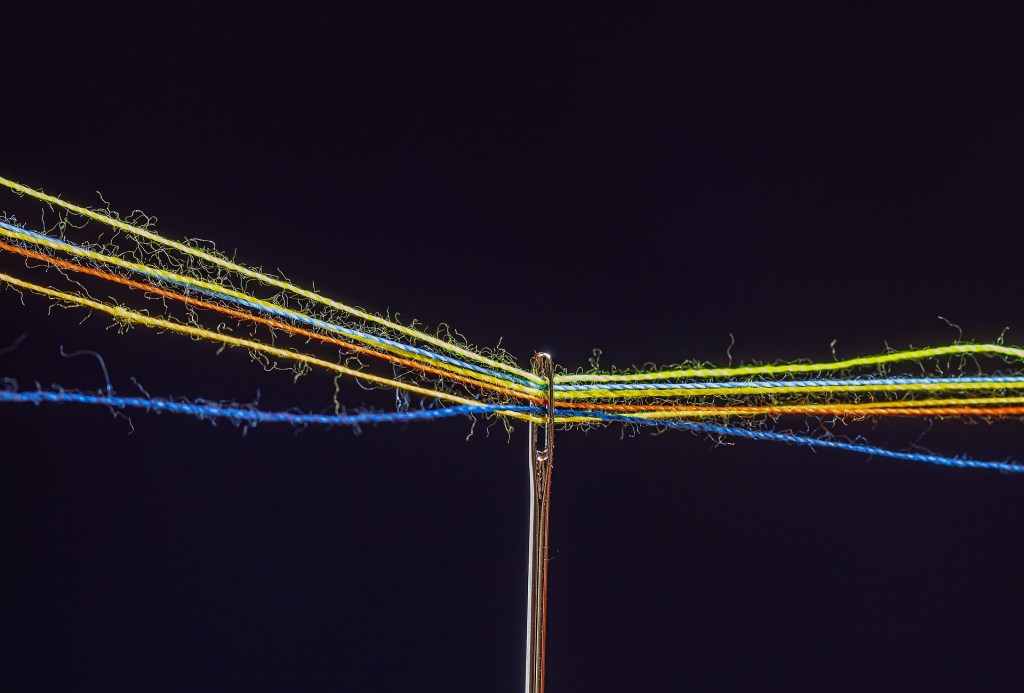
To better understand the idea of being connective, let’s think about clothing. A shirt isn’t a single thing, it is a carefully designed construction of many things. It is thousands, if not millions, of fibers specifically chosen and woven together to create one efficient whole. If too many of those fibers become frayed, if they don’t weave together with the others, if they are of a different material entirely; the shirt is no good and it promptly becomes torn and tattered. At its best, social media should function like a comfortable t-shirt. We are each the core fiber running through the middle, but in order to be our strongest and most beneficial we must weave ourselves together with strong and likely made fibers.
It is true that we might set out to do just that, but often times external factors and unexpected circumstances lead some threads to be snapped, burned, or otherwise made unhelpful to the superstructure. In real life friendships fall apart, acquaintances become lost, and stances tend to be made. Our responsibility to ourselves isn’t to avoid unforeseen circumstances at all cost, but to understand that some threads can only be pulled on so much before they’ve damaged the shirt beyond repair. Snipping is often better than pulling. Yet pulling can be too much fun.
Drama
Nobody wants to be responsible for drama, but everybody loves to have their own little slice of it. It is what makes reality TV so compelling, it is what has made storytelling so successful since long before mankind could even pick up a pen. We like to sit back, take our shots, and count the reactions we get in return.
I write this knowing full well that I’m guilty of this type of pleasure and that social media makes it so easy to get into. I know what kinds of things will invite drama. Whether it’s something trivial, like my hatred of the most recent Star Wars and Spider-Man films, or something religious, political, personal, or private. As a writer I understand that there are times and places to write on each of things, but that the things we say must be said with calculation.
At the same time I often read things that make my blood boil or crawl under my skin and I don’t always show the restraint I need to when engaging with them. I’ll share screenshots and say “can you believe this?”, I’ll subtweet, I’ll forward. I’ll choose to meet negative posts and relationships with negativity of my own. Sometimes the feeling of being a part of something, of being a part of the drama, is too much fun. And when you follow and engage with people you don’t really know it is easy to negate their opinions and beliefs because they cannot really matter to you unless the person posting them does too. This brings me back to my initial point; “Why do we so willingly choose to share the things that matter most to us with people who do not invest in us and to whom we do not invest in?”
Missing Out
In the hubbub and distance of today’s world, sharing with everybody is sometimes the only way to share with anybody. At the end of the day, we don’t want anybody to miss out. We don’t want them to miss out because we care about them. We also don’t want them to miss out because we want them to think that we are the Joneses and that they are keeping up with us. We want to be validated and it is easy to conflate qualitative validation with quantitative validation. Likes, comments, and shares are all quantitative; and positive comments and negative comments both numerically add up the same.
Personal Notes
My blog has been mostly movie related for the past twelve months, and in that period it has been comparatively dormant compared to years past. This past month I came back to it in intimate ways that I haven’t touched on in quite a while. I had stories I needed to tell, I had trauma I needed to unpack. I did so in the most appropriate way that I knew how. I fully stand by what I have written and am proud of taking the time, space, and vulnerability to share what I’ve experienced. That said, ego is a fickle thing and I cannot pretend like the validation I’ve received from them isn’t tempting.
For the most part, the validation has been reassuring. Blinding Sparks received more views than anything I’ve ever written. In the wake of it I received more love, support, and the sharing of other’s stories than I ever could have imagined. At first it was easy to be distracted by the view count, but with a little perspective I find myself having grown to appreciate the personal notes and reaching out more and more. It was a much needed reminder that social media should be an extension of our connectedness with people we care about, not a simulation of it.
On the other hand, there’s been a lot of backlash. I get some of it to an extent, regardless of how I approached my posts, they are still disparaging of another person. There are still people who care about her and I have no right to be surprised by the ways they’ve come to her defense. Yet I still find myself drawn to the subtweets, the mean comments, and the comparisons of my hairline to C-3PO. Whether this commentary is warranted, and some of it genuinely is, or is not; it stings all the same. Let’s unpack an example:
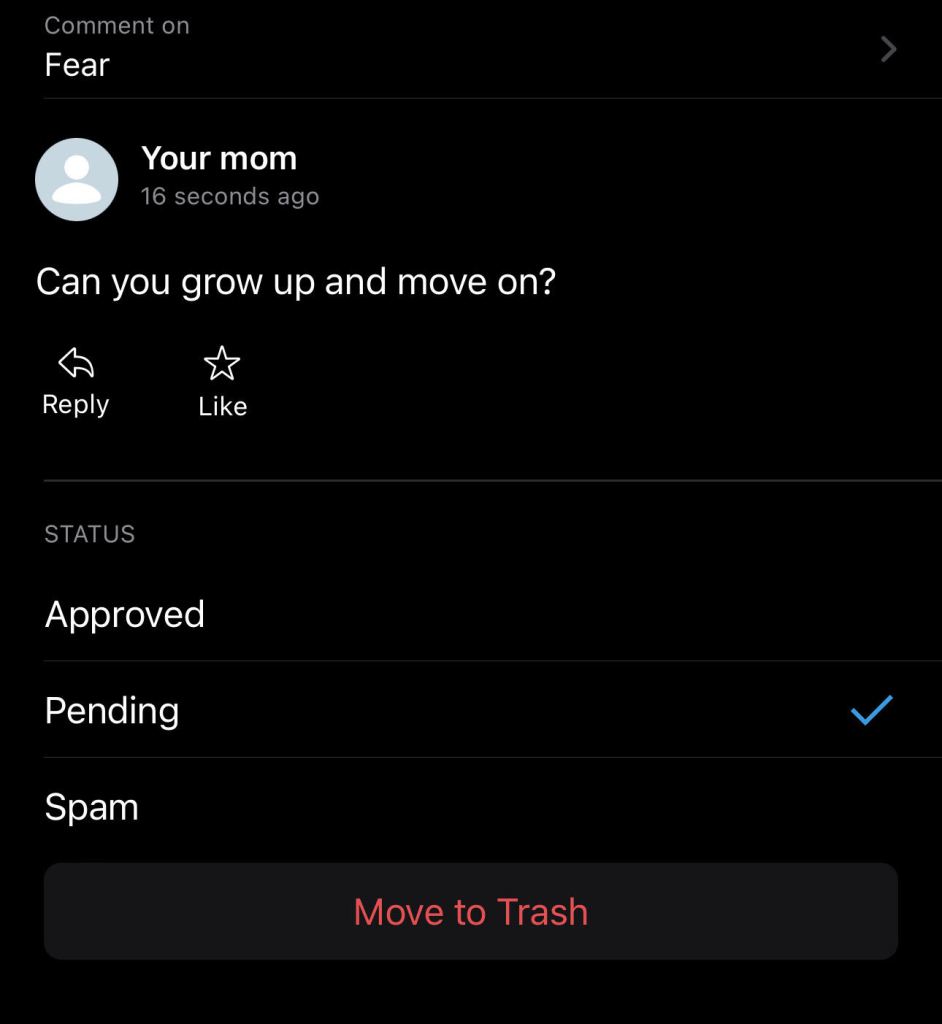
I watched someone sit across from me in the breakroom and type this. It’s stupid, childishly anonymous; and yet it both got under my skin and came from the same place as did the post it was written on. While the execution might be different, we are both standing up for someone we care about. It might sound trivial, but I think that is an important commonality to remember. We might not be seeking the same end goal, but we serve similar functions within our social circles. The difference is that I chose not to be in that social circle any longer, but I was not able to recognize the importance of prioritizing my digital social circle qualitatively rather than quantitively. I took myself out of the frying pan but did nothing to cut off the fire.
It was this backlash that brought this post’s original question to my head, “Why am I following these people who don’t like me?”. In many cases, these people have been legitimately hateful and harmful to me. Yet ego and that innate need to belong kept me from committing fully to that removal. I talked in Coda about pliability and how we are all a product of our environments. This whole experience has been a gut check for my own pliability. I can’t remove myself halfway, because moderate influence is still influence.
My Social Circle
At the end of the day I want the words that come from my keyboard to have positive impact. I believe that the things I have written lately have done a lot of that. It certainly helped me process many things that I was ashamed of and it helped others feel similarly validated in the process. At the same time, anything we say that involves taking a stance is certain to create negative impact. It is our responsibility to tend to our social circles in a way that impedes drama rather than creates it. To put it plainly, we shouldn’t let quantity impede quality. Negative comments, drama, hate; they all hurt. It is easy to let them overshadow love and support. I’m not going to pretend like I have this lesson all figured out, nor that there won’t be further lessons to come; but I will say that I intend to keep approaching this period of setback and growth the same as I always have; with an open mind and an appreciation for the people whom I choose (and am chosen by) to share a social circle.
 Collin Willis